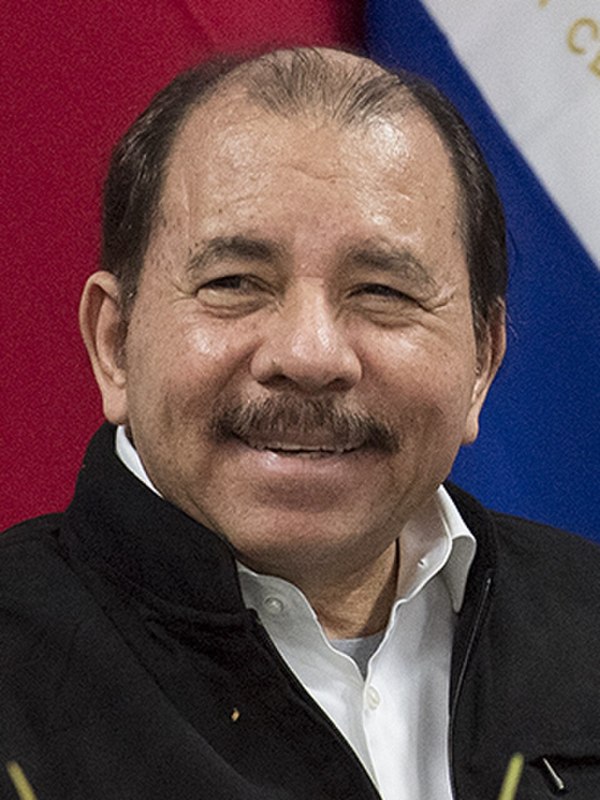
Daniel Ortega at a glance
How long has Ortega been in power?
Daniel Ortega first led Nicaragua as part of the Sandinista junta from 1979 and as elected president from 1985 to 1990, before returning to the presidency in 2007 after winning election that year.
Since his return, Ortega has removed term limits, jailed opposition candidates ahead of elections, and elevated his wife Rosario Murillo to co-president, tightening family control over the state.
Daniel Ortega's political timeline
Ortega becomes a member of the ruling junta after the overthrow of Anastasio Somoza.
Ortega wins Nicaragua's first post-revolution presidential election.
Ortega is defeated by Violeta Chamorro and leaves office.
Ortega wins the presidential election and returns to power.
A constitutional reform removes presidential term limits.
Security forces kill hundreds of demonstrators during nationwide anti-government protests.
Nearly all major presidential challengers are arrested ahead of the election.
Constitutional changes formally elevate Rosario Murillo to co-president.
How did Daniel Ortega come to power?
Ortega first rose to power as a leader of the Sandinista National Liberation Front, which overthrew the Somoza dictatorship in 1979.
After losing power in 1990, he rebuilt his political base over years, returning to the presidency by election in 2007.
How has Daniel Ortega maintained power?
Since 2007, Ortega has systematically dismantled institutional checks, packing courts and electoral bodies with loyalists and removing constitutional term limits.
The 2018 crackdown on protests, in which hundreds were killed, marked a turning point toward more overt repression, followed by the mass jailing and exile of opposition figures, journalists and civil society leaders.
Viewed alongside other leaders Dictator Dashboard tracks in the Americas, such as Delcy Rodríguez in Venezuela and Nayib Bukele in El Salvador, Daniel Ortega's reliance on concentrated executive power and restricted political competition reflects a wider regional pattern.
Key mechanisms of political control
- Abolition of term limits
- Packing of courts and electoral bodies
- Jailing and exile of opposition candidates
- Closure of independent media and NGOs
- Family consolidation of power via co-presidency
Daniel Ortega's elections
| Year | Election / event | Outcome |
|---|---|---|
| 2006 | Presidential election | Won |
| 2011 | Presidential election | Won |
| 2016 | Presidential election | Won |
| 2021 | Presidential election | Won (opposition jailed) |
Election figures and classifications should be linked to the underlying sources used by Dictator Dashboard.
Daniel Ortega's Strongman Index
The Strongman Index measures the concentration and durability of political power around an individual leader. The score is based on the methodology used by Dictator Dashboard.
Is Daniel Ortega a dictator?
Ortega's government is widely classified as authoritarian by international monitors, particularly following the violent 2018 crackdown and the jailing of nearly all viable opposition candidates in 2021.
Dictator Dashboard uses its own inclusion methodology rather than relying on a single external classification. This distinction is important because terms such as "dictator", "autocrat" and "authoritarian leader" are used differently across political research.
Sources & methodology
Dictator Dashboard combines publicly available political, electoral and historical information. Individual claims should be supported by the relevant primary or authoritative source.