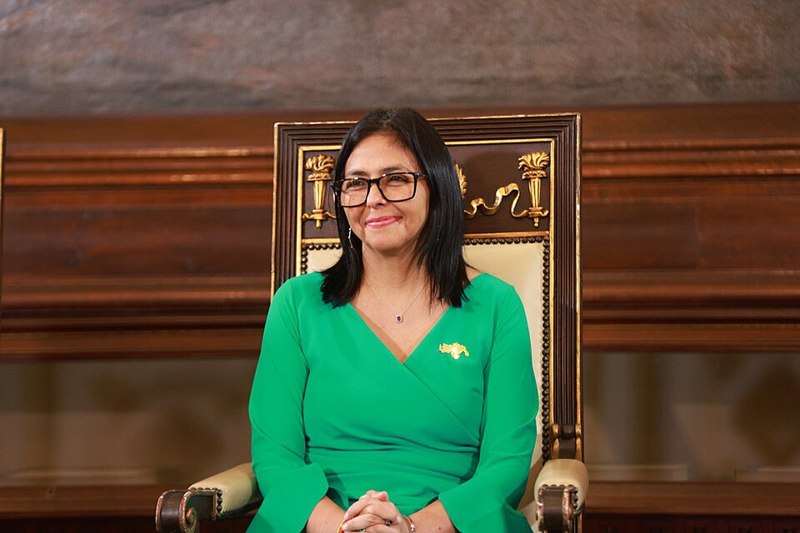
Delcy Rodríguez at a glance
How did Rodríguez come to power?
Delcy Rodríguez, a longtime senior official of the ruling PSUV, became acting president after the United States conducted a military operation on 3 January 2026 that captured President Nicolás Maduro and his wife, flying them to New York to face narco-terrorism charges.
Venezuela's Supreme Tribunal of Justice, controlled by the ruling party, formally directed Rodríguez, who had served as Maduro's vice president since 2018, to assume presidential powers in the aftermath.
Delcy Rodríguez's political timeline
Rodríguez serves as Foreign Minister and later Communications Minister under Maduro.
Rodríguez is appointed Executive Vice President of Venezuela.
Maduro is inaugurated for a third term following a disputed election.
A US military operation captures Maduro and his wife, Cilia Flores, and removes them from Venezuela.
Venezuela's Supreme Tribunal directs Rodríguez to assume presidential powers.
US President Trump publicly recognises Rodríguez's government during regional diplomacy, despite her not having been elected.
The Rodríguez government begins releasing hundreds of political prisoners amid an ongoing US-backed transition process.
How did Delcy Rodríguez come to power?
Rodríguez built her career within the Chavista movement, holding a succession of ministerial posts including Foreign Affairs, Communications and Economy under Presidents Chávez and Maduro before becoming Vice President in 2018.
Her elevation to acting president in January 2026 was not the result of an election but followed the sudden removal of Maduro by US forces, with the ruling party's own institutions installing her to preserve continuity of government.
How has Delcy Rodríguez maintained power?
Rodríguez has continued to rely on the backing of the Venezuelan military high command and the existing PSUV state apparatus to maintain control amid a fragile transition.
Her government has released a number of political prisoners and engaged in renewed diplomacy with Washington, while resisting calls to hand power to opposition figures such as Edmundo González Urrutia, who many observers say won the 2024 election.
Viewed alongside other leaders Dictator Dashboard tracks in the Americas, such as Daniel Ortega in Nicaragua and Nayib Bukele in El Salvador, Delcy Rodríguez's reliance on concentrated executive power and restricted political competition reflects a wider regional pattern.
Key mechanisms of political control
- Continuity of the pre-existing PSUV state apparatus
- Reliance on military high command backing
- Selective release of political prisoners under international pressure
- Exclusion of opposition figures from a transition process
- Dependence on US diplomatic recognition
Delcy Rodríguez's Strongman Index
The Strongman Index measures the concentration and durability of political power around an individual leader. The score is based on the methodology used by Dictator Dashboard.
Is Delcy Rodríguez a dictator?
Rodríguez inherited, rather than built, an authoritarian system, and it remains unsettled whether her government represents genuine transition or the adaptation of Chavista rule under a new face.
Dictator Dashboard uses its own inclusion methodology rather than relying on a single external classification. This distinction is important because terms such as "dictator", "autocrat" and "authoritarian leader" are used differently across political research.
Venezuela after Maduro
Venezuela remains in a period of upheaval following Maduro's January 2026 capture, compounded by devastating earthquakes in June 2026 that killed more than 6,000 people and complicated an already fragile transition.
The United States has outlined a phased plan involving stabilisation, economic recovery and eventual political transition, though the timeline and outcome remain uncertain.
Sources & methodology
Dictator Dashboard combines publicly available political, electoral and historical information. Individual claims should be supported by the relevant primary or authoritative source.