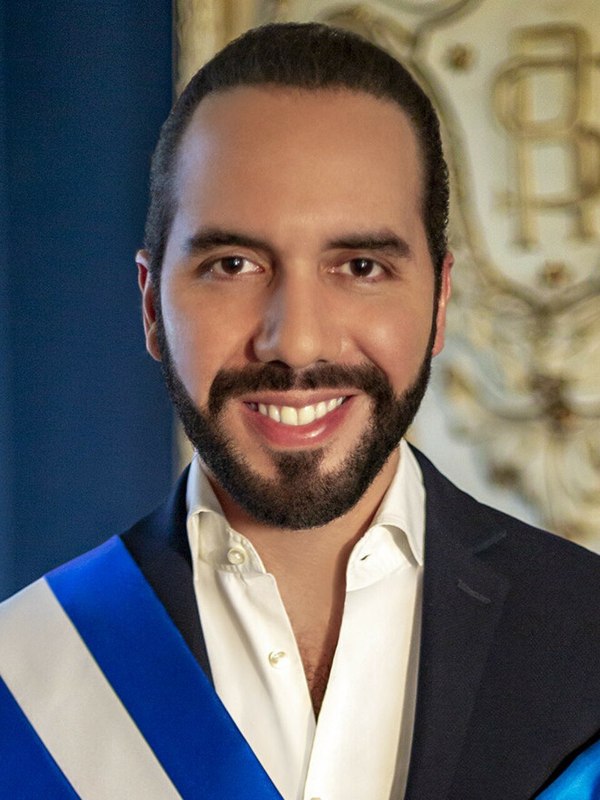
Nayib Bukele at a glance
Why is Bukele on the Strongman Index?
Nayib Bukele became El Salvador's president in 2019 and won a disputed second term in 2024, after a Supreme Court he had reshaped ruled that the constitutional ban on consecutive re-election did not apply to him.
Since 2022, Bukele has governed under a continuously renewed state of emergency that has led to the mass incarceration of tens of thousands of alleged gang members, dramatically reducing crime while drawing criticism over due process.
Nayib Bukele's political timeline
Bukele wins the presidency as a political outsider.
Bukele sends armed soldiers into the legislative chamber to pressure lawmakers over a security bill.
A new legislature dominated by Bukele's party removes Supreme Court judges and the attorney general.
A gang crackdown begins following a surge in homicides, suspending certain constitutional rights.
Bukele wins a second term after a reshaped court permits his candidacy despite a one-term limit.
The state of emergency remains in force, with tens of thousands still detained.
How did Nayib Bukele come to power?
Bukele, a former mayor of San Salvador, won the 2019 presidential election as the candidate of a small party, breaking the two-party system that had dominated Salvadoran politics for decades.
After his party won a supermajority in 2021, the new legislature removed the sitting Supreme Court and attorney general, replacing them with judges who later cleared the path for his re-election.
How has Nayib Bukele maintained power?
Bukele's 2022 state of emergency suspended rights including access to a lawyer and led to the arrest of tens of thousands of people on suspected gang affiliation, with human rights groups documenting wrongful detentions.
The crackdown has coincided with a dramatic fall in El Salvador's homicide rate, driving Bukele's high domestic popularity even as international rights organisations raise due-process concerns.
Compared with other leaders on the Strongman Index from the Americas, such as Delcy Rodríguez in Venezuela and Daniel Ortega in Nicaragua, Bukele illustrates how democratic norms can be tested without a full collapse into authoritarian rule.
Key mechanisms of political control
- Removal of an independent Supreme Court and attorney general
- Continuously renewed state of emergency
- Mass detention with suspended due-process rights
- Judicial reinterpretation enabling re-election
- Military pressure on the legislature (2020)
Nayib Bukele's elections
| Year | Election / event | Outcome |
|---|---|---|
| 2019 | Presidential election | Won |
| 2024 | Presidential election | Won |
Election figures and classifications should be linked to the underlying sources used by Dictator Dashboard.
Nayib Bukele's Strongman Index
The Strongman Index measures the concentration and durability of political power around an individual leader. The score is based on the methodology used by Dictator Dashboard.
Is Nayib Bukele a dictator?
Bukele remains highly popular domestically for his security crackdown, but international rights and legal organisations have raised significant concerns about judicial independence and due process under his rule.
Dictator Dashboard uses its own inclusion methodology rather than relying on a single external classification. This distinction is important because terms such as "dictator", "autocrat" and "authoritarian leader" are used differently across political research.
Sources & methodology
Dictator Dashboard combines publicly available political, electoral and historical information. Individual claims should be supported by the relevant primary or authoritative source.