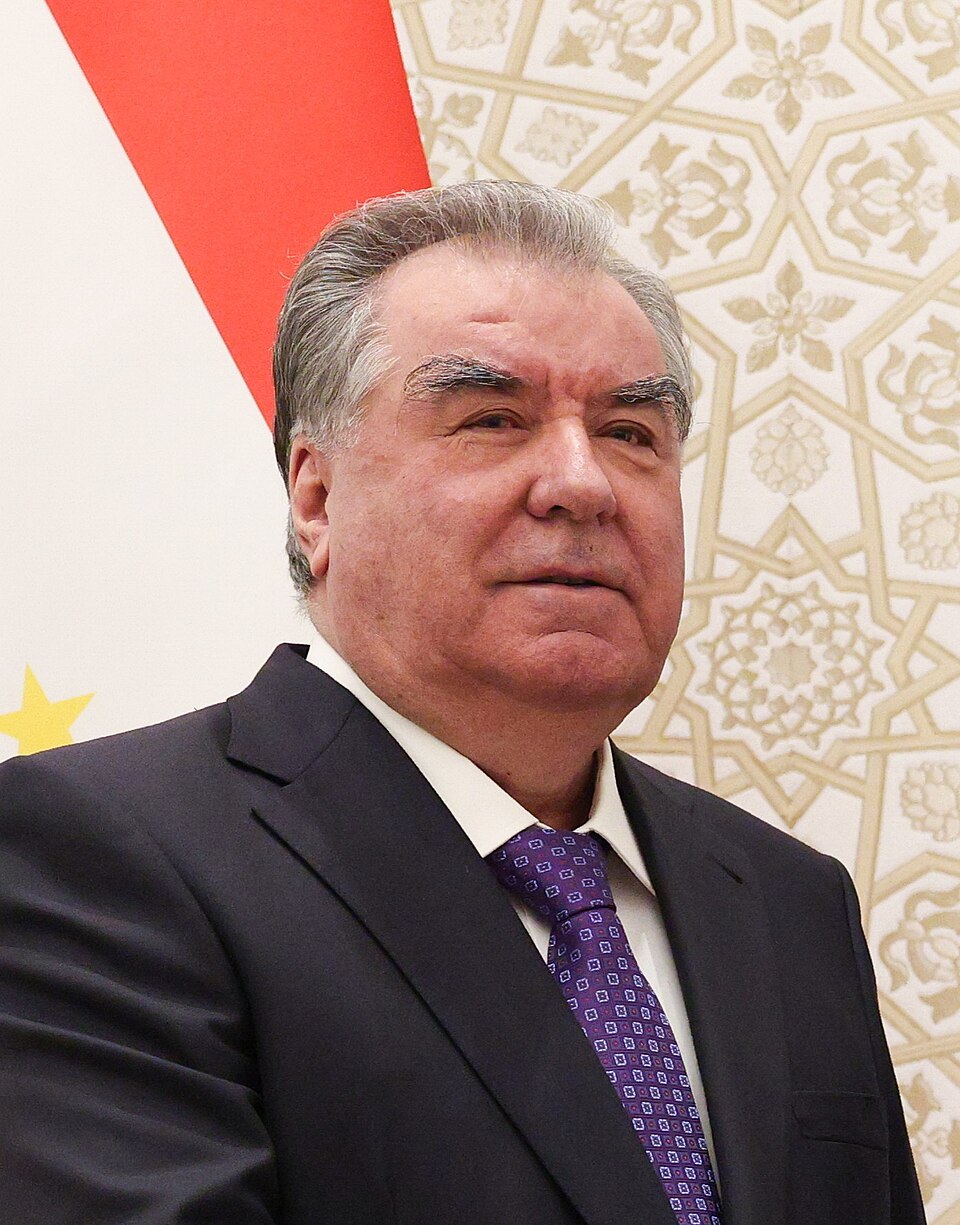
Emomali Rahmon at a glance
How long has Rahmon been in power?
Emomali Rahmon became head of Tajikistan's government in 1992 during a civil war and was elected president in 1994, a position he has held for over three decades.
Constitutional amendments have repeatedly extended his rule, removed term limits for him personally, and granted him and his family lifetime legal immunity.
Emomali Rahmon's political timeline
Rahmon takes leadership amid Tajikistan's civil war.
Rahmon wins Tajikistan's first post-independence presidential election.
A referendum lengthens the presidential term.
A referendum allows Rahmon to serve two additional seven-year terms.
Rahmon is granted the official title and lifetime immunity, and term limits are lifted for him alone.
Rustam Emomali is made speaker of the upper house, next in line to the presidency.
How did Emomali Rahmon come to power?
Rahmon rose to leadership amid Tajikistan's 1992–1997 civil war, emerging as head of state through the Popular Front faction that consolidated post-Soviet power.
He was formally elected president in 1994 and has since used referendums to repeatedly extend and secure his rule.
How has Emomali Rahmon maintained power?
Rahmon's government tightly restricts independent media, religious expression and political opposition, with the country's only genuine opposition party banned as extremist.
State institutions, security services and the economy are closely tied to the Rahmon family, which is widely reported to control major business interests.
Viewed alongside other leaders Dictator Dashboard tracks in Asia, such as Narendra Modi in India and Min Aung Hlaing in Myanmar, Emomali Rahmon's reliance on concentrated executive power and restricted political competition reflects a wider regional pattern.
Key mechanisms of political control
- Constitutional carve-outs granting personal immunity and unlimited terms
- Ban on the country's leading opposition party
- Family control of key economic sectors
- Restrictions on religious practice and dress
- Grooming of a son as heir apparent
Emomali Rahmon's elections
| Year | Election / event | Outcome |
|---|---|---|
| 1994 | Presidential election | Won |
| 2006 | Presidential election | Won |
| 2013 | Presidential election | Won |
| 2020 | Presidential election | Won |
Election figures and classifications should be linked to the underlying sources used by Dictator Dashboard.
Emomali Rahmon's Strongman Index
The Strongman Index measures the concentration and durability of political power around an individual leader. The score is based on the methodology used by Dictator Dashboard.
Is Emomali Rahmon a dictator?
Rahmon's Tajikistan is consistently rated among the least free countries in Central Asia, with no genuine political opposition and pervasive state control of religion and media.
Dictator Dashboard uses its own inclusion methodology rather than relying on a single external classification. This distinction is important because terms such as "dictator", "autocrat" and "authoritarian leader" are used differently across political research.
Sources & methodology
Dictator Dashboard combines publicly available political, electoral and historical information. Individual claims should be supported by the relevant primary or authoritative source.