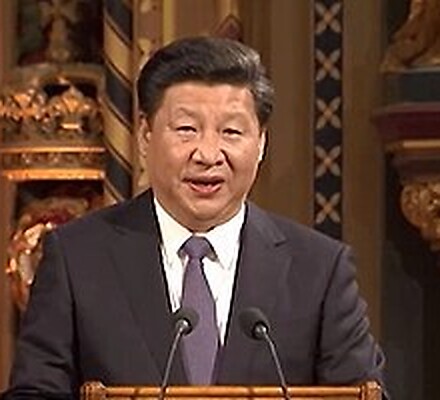
Xi Jinping at a glance
How long has Xi Jinping been in power?
Xi Jinping became General Secretary of the Communist Party of China in November 2012 and state president in March 2013, quickly consolidating control over the party, state and military.
In 2018, China's legislature removed the two-term limit on the presidency that had been in place since the 1990s, eliminating a key institutional check and opening the door to indefinite rule.
Xi Jinping's political timeline
Xi is named General Secretary of the Communist Party at the 18th Party Congress.
Xi is elected President of the People's Republic of China.
The Party Congress enshrines Xi's political philosophy in the party constitution, elevating his status.
China's legislature removes the two-term limit on the presidency.
The party adopts only its third such resolution, placing Xi alongside Mao and Deng.
Xi is confirmed for a norm-breaking third term as General Secretary.
Xi begins a third term as state president.
How did Xi Jinping come to power?
Xi rose through provincial party leadership positions in Fujian, Zhejiang and Shanghai before joining the Politburo Standing Committee in 2007 and being designated Hu Jintao's successor.
He assumed the party's top post in 2012 and used a sweeping anti-corruption campaign to remove rivals and consolidate authority across the party and military.
How has Xi Jinping maintained power?
Xi has centralised decision-making around himself to a degree unseen since Mao, chairing numerous leading small groups that bypass traditional collective-leadership structures.
Extensive censorship, a vast surveillance apparatus and a broadly defined national security law have narrowed space for dissent, while the anti-corruption campaign has doubled as a tool for eliminating political rivals.
Viewed alongside other leaders Dictator Dashboard tracks in Asia, such as Narendra Modi in India and Min Aung Hlaing in Myanmar, Xi Jinping's reliance on concentrated executive power and restricted political competition reflects a wider regional pattern.
Key mechanisms of political control
- Abolition of presidential term limits
- Mass digital surveillance and censorship
- Anti-corruption campaigns targeting rivals
- Enshrinement of personal ideology in party doctrine
- Tight control of the military via the Central Military Commission
Xi Jinping's Strongman Index
The Strongman Index measures the concentration and durability of political power around an individual leader. The score is based on the methodology used by Dictator Dashboard.
Is Xi Jinping a dictator?
Xi is widely classified as an authoritarian leader by international democracy and human rights researchers, presiding over a one-party state with tightly controlled media and political expression.
Dictator Dashboard uses its own inclusion methodology rather than relying on a single external classification. This distinction is important because terms such as "dictator", "autocrat" and "authoritarian leader" are used differently across political research.
Sources & methodology
Dictator Dashboard combines publicly available political, electoral and historical information. Individual claims should be supported by the relevant primary or authoritative source.