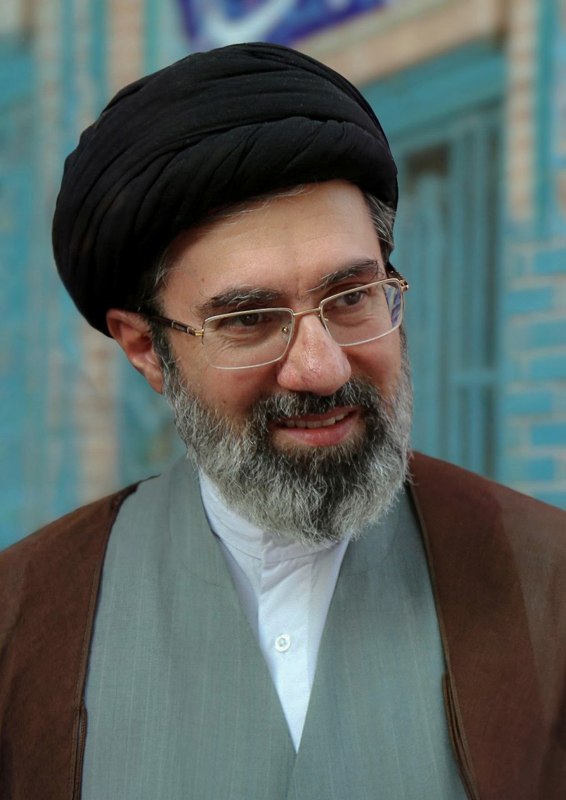
Mojtaba Khamenei at a glance
How did Mojtaba Khamenei come to power?
Mojtaba Khamenei was elected Iran's third Supreme Leader by the Assembly of Experts on 8 March 2026, roughly a week after his father, longtime Supreme Leader Ali Khamenei, was killed in a joint United States-Israeli strike on a Tehran compound that opened the 2026 Iran war.
Although he had never held a formal government position, Khamenei was widely known as an influential behind-the-scenes figure in his father's office, and the security establishment, including the Revolutionary Guard Corps, quickly pledged its backing.
Mojtaba Khamenei's political timeline
Mojtaba is given a formal advisory role within his father's office, though he holds no elected or public post.
Reformist candidates accuse Mojtaba of working to secure the disputed re-election of President Ahmadinejad.
US-Israeli strikes on a Tehran compound kill Supreme Leader Ali Khamenei and senior officials, opening the 2026 Iran war.
A council including the president and chief justice temporarily assumes leadership functions.
The Assembly of Experts elects Mojtaba Khamenei as Iran's third Supreme Leader.
Khamenei's first statement as leader is read by a television anchor; he has not appeared in video since.
How did Mojtaba Khamenei come to power?
Mojtaba Khamenei spent decades as an influential but largely unelected figure inside his father's office, described in leaked diplomatic cables as a key gatekeeper with informal command influence over the Basij militia.
His formal ascension came only after his father's assassination, when the Assembly of Experts, dominated by hardline clerics, elected him within days despite his lack of prior government experience.
How has Mojtaba Khamenei maintained power?
Khamenei has governed largely from the shadows since taking office, with statements attributed to him read by state broadcasters rather than delivered in person, fuelling speculation about his health and whereabouts.
Analysts describe his leadership as operating within a broader security-elite consensus rather than the more singular authority his father held, amid an ongoing war and internal divisions among hardline factions.
Viewed alongside other leaders Dictator Dashboard tracks in the Middle East, such as Bashar al-Assad in Syria and Mohammed bin Salman in Saudi Arabia, Mojtaba Khamenei's reliance on concentrated executive power and restricted political competition reflects a wider regional pattern.
Key mechanisms of political control
- Selection by a hardline-dominated Assembly of Experts
- Backing of the Revolutionary Guard Corps
- Continuation of pervasive internal security controls
- Limited public transparency about the leader's condition
- Reliance on a broader security-elite consensus for decisions
Mojtaba Khamenei's Strongman Index
The Strongman Index measures the concentration and durability of political power around an individual leader. The score is based on the methodology used by Dictator Dashboard.
Is Mojtaba Khamenei a dictator?
Iran's Supreme Leader role carries sweeping constitutional authority over the judiciary, military and legislature, and Khamenei inherited a system long classified as authoritarian by independent researchers.
Dictator Dashboard uses its own inclusion methodology rather than relying on a single external classification. This distinction is important because terms such as "dictator", "autocrat" and "authoritarian leader" are used differently across political research.
The 2026 Iran war
Ali Khamenei's assassination on 28 February 2026 opened a wider war between Iran and a US-Israeli coalition, with strikes continuing across the region for weeks and disruption to shipping through the Strait of Hormuz.
Mojtaba Khamenei's public absence during the conflict has fuelled ongoing uncertainty about who is effectively directing Iranian policy.
Sources & methodology
Dictator Dashboard combines publicly available political, electoral and historical information. Individual claims should be supported by the relevant primary or authoritative source.