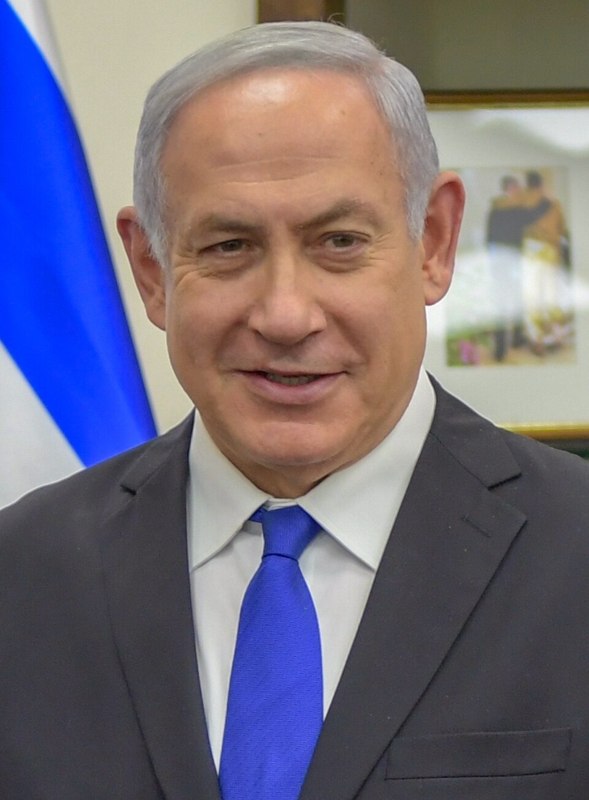
Benjamin Netanyahu at a glance
Why is Netanyahu on the Strongman Index?
Benjamin Netanyahu has served as Israel's prime minister across several non-consecutive periods since 1996, making him the country's longest-serving leader, and returned to office in December 2022 heading a coalition with far-right and religious parties.
His government's 2023 push to overhaul the judiciary triggered months of mass protests before being partly paused following the October 2023 Hamas attack and the subsequent war in Gaza.
Benjamin Netanyahu's political timeline
Netanyahu wins election to become Israel's youngest-ever prime minister.
Netanyahu begins a continuous run as prime minister lasting until 2021.
Netanyahu is formally indicted on charges of bribery, fraud and breach of trust.
Netanyahu forms a coalition with far-right and ultra-Orthodox parties after the November election.
Proposed reforms to weaken judicial review trigger the largest protest movement in Israeli history.
An attack by Hamas on 7 October 2023 leads to a prolonged war in Gaza.
The conflict continues alongside domestic and international criticism of its conduct and humanitarian toll.
How did Benjamin Netanyahu come to power?
Netanyahu first became prime minister in 1996 and has since served multiple terms across nearly three decades, making him Israel's longest-serving head of government.
He returned to office in December 2022 after forming a coalition with far-right and ultra-Orthodox parties following a closely contested general election.
How has Benjamin Netanyahu maintained power?
Netanyahu's coalition pursued a 2023 judicial overhaul that critics said would severely weaken the Supreme Court's independence, prompting sustained mass protests before the effort was largely shelved after the war began.
He has continued to govern while standing trial on corruption charges first filed in 2019, and has faced both domestic and international criticism over the conduct and humanitarian consequences of the Gaza war.
Compared with other leaders on the Strongman Index from the Middle East, such as Mojtaba Khamenei in Iran and Bashar al-Assad in Syria, Netanyahu illustrates how democratic norms can be tested without a full collapse into authoritarian rule.
Key mechanisms of political control
- Coalition alliance with far-right and religious parties
- Attempted weakening of judicial review powers
- Continuation in office while under criminal indictment
- Wartime emergency governance since October 2023
- Extended state-of-war political dynamics
Benjamin Netanyahu's elections
| Year | Election / event | Outcome |
|---|---|---|
| 2009 | General election | Won |
| 2015 | General election | Won |
| 2022 | General election | Won |
Election figures and classifications should be linked to the underlying sources used by Dictator Dashboard.
Benjamin Netanyahu's Strongman Index
The Strongman Index measures the concentration and durability of political power around an individual leader. The score is based on the methodology used by Dictator Dashboard.
Is Benjamin Netanyahu a dictator?
Israel retains a competitive multiparty system, an independent judiciary and a free press, though the 2023 judicial overhaul push raised significant domestic concern about checks on executive power.
Dictator Dashboard uses its own inclusion methodology rather than relying on a single external classification. This distinction is important because terms such as "dictator", "autocrat" and "authoritarian leader" are used differently across political research.
The Gaza war
The war that began after the 7 October 2023 Hamas attack has continued for over two years, with major humanitarian, political and diplomatic consequences that have dominated Netanyahu's most recent term.
Sources & methodology
Dictator Dashboard combines publicly available political, electoral and historical information. Individual claims should be supported by the relevant primary or authoritative source.