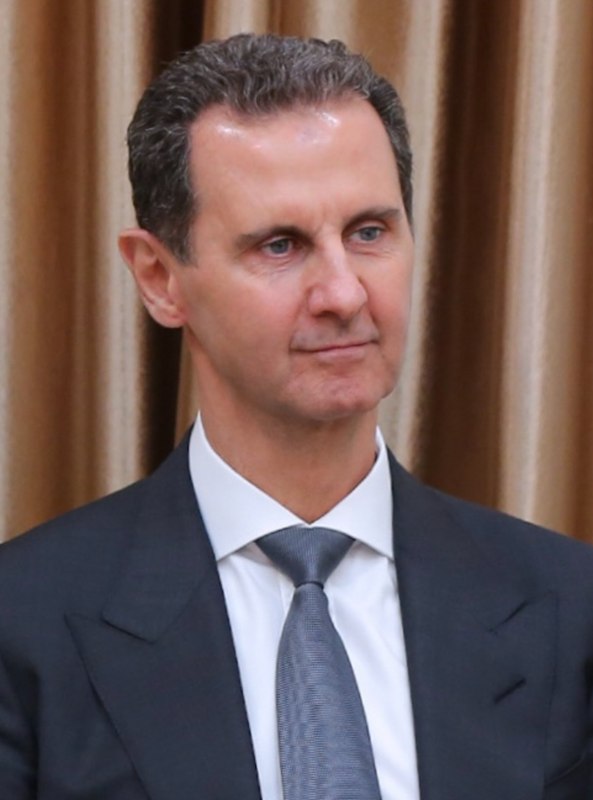
Bashar al-Assad at a glance
How did Assad fall from power?
Bashar al-Assad succeeded his father, Hafez al-Assad, as president in 2000, continuing a family dynasty that had ruled Syria since 1971, until a rapid rebel offensive captured Damascus in December 2024.
His government's brutal suppression of the 2011 uprising plunged Syria into a civil war that killed hundreds of thousands and displaced millions, before a renewed rebel offensive led by Hayat Tahrir al-Sham ended his rule within days.
Bashar al-Assad's political timeline
Bashar al-Assad becomes president after the death of Hafez al-Assad.
Pro-democracy protests as part of the Arab Spring are met with a violent crackdown, sparking civil war.
The Assad government is accused of using chemical weapons against civilians near Damascus.
Russian military intervention helps stabilise the Assad government against rebel and jihadist forces.
The conflict settles into a prolonged stalemate with Assad controlling most major population centres.
Hayat Tahrir al-Sham launches a rapid offensive from Idlib province.
Rebel forces enter Damascus; Assad flees the country as his government collapses.
Assad and his family are confirmed to have been granted asylum in Moscow.
How did Bashar al-Assad come to power?
Bashar al-Assad was not originally groomed for leadership, training as an ophthalmologist in London, but became heir apparent after his elder brother Bassel died in a 1994 car accident.
He assumed the presidency in 2000 following his father's death, with parliament quickly amending the constitution to lower the minimum eligible age to allow his succession.
How has Bashar al-Assad maintained power?
Assad's government suppressed the 2011 pro-democracy uprising with lethal force, triggering a civil war in which his forces, backed by Russia and Iran, were repeatedly accused of using chemical weapons and targeting civilian areas.
Despite years of grinding stalemate, a renewed rebel offensive in late 2024 exploited weakened Russian and Iranian support to sweep through Syria in under two weeks, ending Assad's rule.
Assad's fall from power invites comparison with other cases Dictator Dashboard tracks in the Middle East, including Mojtaba Khamenei in Iran and Mohammed bin Salman in Saudi Arabia, both of whom have relied on similar tools to hold on to power.
Key mechanisms of political control
- Violent suppression of the 2011 uprising
- Alleged use of chemical weapons against civilians
- Reliance on Russian and Iranian military backing
- Mass detention and documented torture in state prisons
- Eventual collapse when foreign backing weakened
Bashar al-Assad's Strongman Index
The Strongman Index measures the concentration and durability of political power around an individual leader. The score is based on the methodology used by Dictator Dashboard.
Is Bashar al-Assad a dictator?
Assad's government was widely classified by international bodies as one of the most repressive in the world, with documented use of chemical weapons and systematic torture in state detention facilities.
Dictator Dashboard uses its own inclusion methodology rather than relying on a single external classification. This distinction is important because terms such as "dictator", "autocrat" and "authoritarian leader" are used differently across political research.
Life after the fall
Assad and his family were granted asylum in Russia following his December 2024 flight from Damascus. Syria has since been governed by a transitional administration led by former rebel commander Ahmed al-Sharaa.
Sources & methodology
Dictator Dashboard combines publicly available political, electoral and historical information. Individual claims should be supported by the relevant primary or authoritative source.