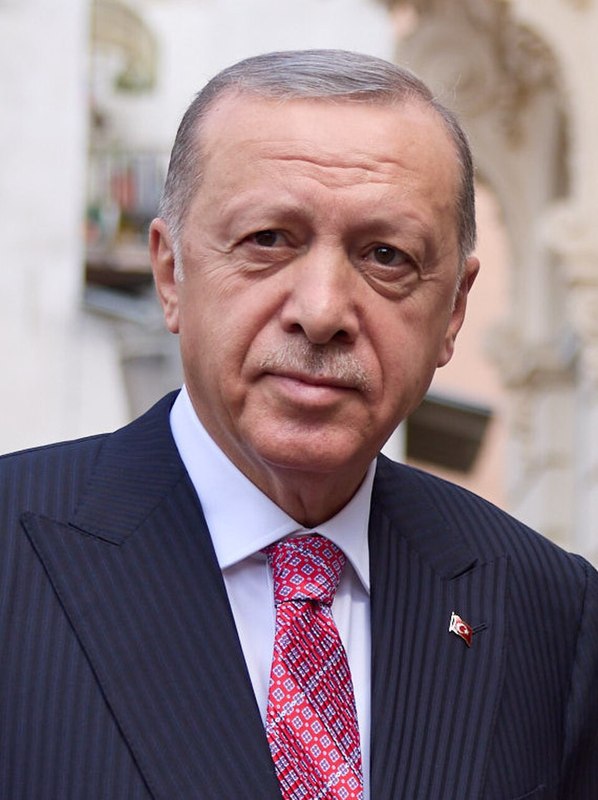
Recep Tayyip Erdoğan at a glance
Why is Erdoğan on the Strongman Index?
Erdoğan served as Turkey's prime minister from 2003 to 2014 before becoming president, a role whose powers were greatly expanded following a narrowly won 2017 constitutional referendum.
Following a failed 2016 coup attempt, his government launched a sweeping crackdown that saw tens of thousands of soldiers, judges, academics and journalists dismissed or jailed.
Recep Tayyip Erdoğan's political timeline
Erdoğan takes office as Turkey's prime minister.
Erdoğan wins Turkey's first direct presidential election.
A failed military coup is followed by a mass purge of the judiciary, military, academia and media.
A narrowly passed referendum converts Turkey to an executive presidential system.
Erdoğan is re-elected under the new system with greatly expanded powers.
Erdoğan wins another term despite a severe cost-of-living crisis.
Istanbul's opposition mayor and potential presidential rival, Ekrem İmamoğlu, is arrested on corruption charges he calls politically motivated.
How did Recep Tayyip Erdoğan come to power?
Erdoğan rose through Islamist politics and served as mayor of Istanbul before founding the AKP and becoming prime minister in 2003.
He transitioned to the presidency in 2014 and secured a 2017 referendum that converted Turkey to a strong executive presidential system.
How has Recep Tayyip Erdoğan maintained power?
Following the 2016 coup attempt, Erdoğan's government dismissed or detained more than 100,000 public officials, soldiers, judges and academics, and closed dozens of media outlets.
Prominent opposition politicians, including Istanbul mayor Ekrem İmamoğlu, have faced prosecution widely seen by critics as politically motivated ahead of future elections.
Compared with other leaders on the Strongman Index from Europe, such as Viktor Orbán in Hungary and Aleksandar Vučić in Serbia, Erdoğan illustrates how democratic norms can be tested without a full collapse into authoritarian rule.
Key mechanisms of political control
- Post-coup mass purge of institutions
- Constitutional shift to an executive presidency
- Prosecution of opposition politicians and journalists
- Consolidation of media ownership among allies
- Extended states of emergency
Recep Tayyip Erdoğan's elections
| Year | Election / event | Outcome |
|---|---|---|
| 2014 | Presidential election | Won |
| 2018 | Presidential election | Won |
| 2023 | Presidential election | Won |
Election figures and classifications should be linked to the underlying sources used by Dictator Dashboard.
Recep Tayyip Erdoğan's Strongman Index
The Strongman Index measures the concentration and durability of political power around an individual leader. The score is based on the methodology used by Dictator Dashboard.
Is Recep Tayyip Erdoğan a dictator?
Turkey retains competitive multiparty elections but is widely classified by researchers as a 'competitive authoritarian' system given the scale of media control and prosecution of political opponents.
Dictator Dashboard uses its own inclusion methodology rather than relying on a single external classification. This distinction is important because terms such as "dictator", "autocrat" and "authoritarian leader" are used differently across political research.
Sources & methodology
Dictator Dashboard combines publicly available political, electoral and historical information. Individual claims should be supported by the relevant primary or authoritative source.