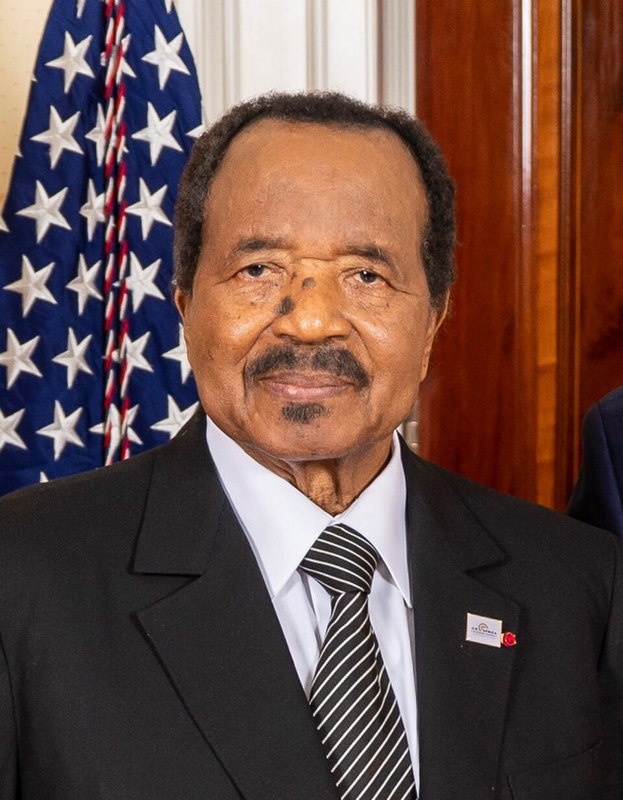
Paul Biya at a glance
How long has Biya been in power?
Paul Biya became president of Cameroon in November 1982 after the resignation of his predecessor, Ahmadou Ahidjo, and has remained in office ever since, making him Africa's oldest sitting head of state.
A 2008 constitutional amendment removed presidential term limits, allowing Biya to continue seeking re-election despite his advanced age and rare public appearances in recent years.
Paul Biya's political timeline
Biya assumes the presidency after Ahmadou Ahidjo's resignation.
Biya survives an attempted military coup shortly after consolidating power.
Cameroon reintroduces multiparty elections amid domestic and international pressure.
A constitutional amendment removes limits on presidential terms.
An armed separatist conflict erupts in Cameroon's English-speaking regions.
Biya wins another term as the Anglophone crisis continues to displace hundreds of thousands.
How did Paul Biya come to power?
Biya served as prime minister under founding president Ahmadou Ahidjo before assuming the presidency upon Ahidjo's resignation in 1982.
He survived an attempted coup in 1984 tied to loyalists of his predecessor, after which he moved to consolidate control over the security forces and ruling party.
How has Paul Biya maintained power?
Biya's government has restricted opposition activity and independent media over decades, while the 2008 removal of term limits eliminated a key institutional check on his rule.
Since 2017, Cameroon has faced an armed conflict in its Anglophone regions, with the government accused of heavy-handed military responses that have displaced hundreds of thousands of people.
Viewed alongside other leaders Dictator Dashboard tracks in Africa, such as Ismail Omar Guelleh in Djibouti and Paul Kagame in Rwanda, Paul Biya's reliance on concentrated executive power and restricted political competition reflects a wider regional pattern.
Key mechanisms of political control
- Abolition of presidential term limits
- Restrictions on opposition parties and media
- Long periods of absence from public view
- Military response to the Anglophone separatist conflict
- Patronage networks tied to the ruling CPDM party
Paul Biya's elections
| Year | Election / event | Outcome |
|---|---|---|
| 1984 | Presidential election | Won |
| 1992 | Presidential election | Won |
| 2004 | Presidential election | Won |
| 2011 | Presidential election | Won |
| 2018 | Presidential election | Won |
Election figures and classifications should be linked to the underlying sources used by Dictator Dashboard.
Paul Biya's Strongman Index
The Strongman Index measures the concentration and durability of political power around an individual leader. The score is based on the methodology used by Dictator Dashboard.
Is Paul Biya a dictator?
Biya's Cameroon is widely characterised by researchers as an entrenched authoritarian system, compounded in recent years by an unresolved internal armed conflict.
Dictator Dashboard uses its own inclusion methodology rather than relying on a single external classification. This distinction is important because terms such as "dictator", "autocrat" and "authoritarian leader" are used differently across political research.
Sources & methodology
Dictator Dashboard combines publicly available political, electoral and historical information. Individual claims should be supported by the relevant primary or authoritative source.