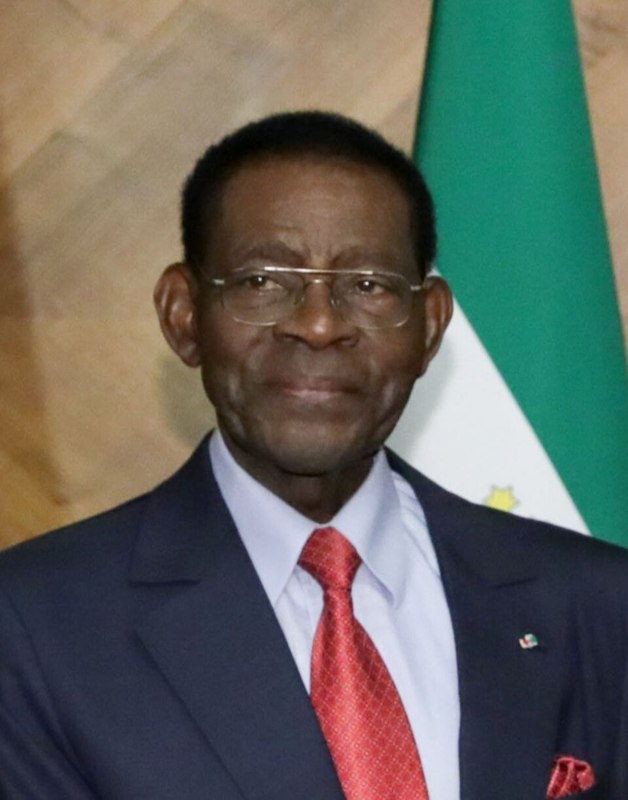
Teodoro Obiang Nguema Mbasogo at a glance
How long has Obiang been in power?
Teodoro Obiang seized power in Equatorial Guinea in a 1979 military coup against his uncle, Francisco Macías Nguema, who was subsequently tried and executed.
Obiang has since won a series of elections with implausibly high margins, and his son Teodorín Obiang has been positioned as vice president and likely successor.
Teodoro Obiang Nguema Mbasogo's political timeline
Obiang overthrows his uncle, President Macías Nguema, who is later executed.
Major offshore oil discoveries transform the country's economy, with revenues concentrated around the ruling family.
Obiang is re-elected with a implausibly high vote share, typical of subsequent elections.
Teodorín Obiang begins holding senior government posts.
Obiang secures another term amid opposition claims of widespread fraud.
Teodorín Obiang is formally installed as vice president, cementing succession plans.
How did Teodoro Obiang Nguema Mbasogo come to power?
Obiang served as a senior military officer and head of the national guard under his uncle before leading the 1979 coup that brought him to power.
He has remained president ever since, presiding over the country's transformation into a major oil exporter from the mid-1990s onward.
How has Teodoro Obiang Nguema Mbasogo maintained power?
Obiang's government tightly restricts political opposition and independent media, and his family is widely reported to control a large share of the country's oil wealth despite most citizens living in poverty.
His son, Teodorín Obiang, has faced international corruption investigations over lavish personal spending while serving as vice president and heir apparent.
Viewed alongside other leaders Dictator Dashboard tracks in Africa, such as Ismail Omar Guelleh in Djibouti and Paul Kagame in Rwanda, Teodoro Obiang's reliance on concentrated executive power and restricted political competition reflects a wider regional pattern.
Key mechanisms of political control
- Elections with implausibly lopsided results
- Family control of oil-derived wealth
- Restrictions on opposition parties and press
- Grooming of a son as designated successor
- Security force loyalty concentrated around the family
Teodoro Obiang Nguema Mbasogo's elections
| Year | Election / event | Outcome |
|---|---|---|
| 1996 | Presidential election | Won (97.85%) |
| 2002 | Presidential election | Won (97.1%) |
| 2009 | Presidential election | Won (95.4%) |
| 2016 | Presidential election | Won (93.7%) |
| 2022 | Presidential election | Won (94.9%) |
Election figures and classifications should be linked to the underlying sources used by Dictator Dashboard.
Teodoro Obiang Nguema Mbasogo's Strongman Index
The Strongman Index measures the concentration and durability of political power around an individual leader. The score is based on the methodology used by Dictator Dashboard.
Is Teodoro Obiang Nguema Mbasogo a dictator?
Obiang's government is consistently rated among the world's most repressive and least transparent by independent democracy and corruption researchers.
Dictator Dashboard uses its own inclusion methodology rather than relying on a single external classification. This distinction is important because terms such as "dictator", "autocrat" and "authoritarian leader" are used differently across political research.
Sources & methodology
Dictator Dashboard combines publicly available political, electoral and historical information. Individual claims should be supported by the relevant primary or authoritative source.